
Vietnam’s Mekong Delta defines the way of life for the Southernmost tip of the long and varied country.
As the Mekong river widens out, it becomes the lifeblood of the area and the main support for most of the people living around and on top of it.
I missed seeing the Delta on my last trip to Vietnam and was eager to see if the second time round, before it was too late.
Due to dams up stream and climate change, it is fast disappearing and expected to disappear in the coming decades.
We blocked out a day to take a tour into the islands of the Delta before our flight home from Ho Chi Minh City (Saigon). (If we had more time, we absolutely would have flown in to Can Tho and experienced the famous floating markets).
Let’s skip past the booking drama when we found out our booking had been cancelled by mistake an hour before we were set to be picked up, and a frantic WhatsApp exchange to get us back on the boat…
By about 9am we found ourselves on a minibus working through the rush hour scooter chaos with a few retirees and an Indian couple (very-impressively) touring Vietnam with their one-year old son.
The bus had picked us up from our hotel in Ho Chi Minh City, and soon we were winding our way out of the traffic towards the south. It was a two-hour drive, and our guide filled the time with an introduction to Vietnamese culture and history.
It was actually a very helpful introduction – rather ironically coming right at the end of our trip. But it answered the questions we’d had about the festival flags, or how the many many temples fit into life in a communist state.


Our first stop was Vinh Trang Pagoda, the largest in the delta region. It is an active place of worship, with incense burning and monks moving quietly between the shrines, but at the same time tourists were wandering around, snapping photos.
The mix of the sacred and the touristic was certainly unique.
But it was also brutally hot standing out in the sun, so after a quick walk round most of the group made a beeline for the shade until it was time to get back on the bus.
From there we drove to the boat terminal. The first boat we got was a larger wooden boat with a face painted on the front with bright eyes staring out over the water.
Our guide explained that this is an old tradition: the eyes ward off sea monsters and bring good luck to the fishermen.
Our boat, with its cheerful painted eyes, ferried us out across the wide brown waters of the Mekong to the first of the islands and this is where the day really began!


The day unfolded as a series of stops and starts, hopping on and off boats, tuk tuks, and bicycles.
We tried fresh honey straight from the comb, then sampled exotic local fruits while a small group of musicians played folk songs for us.
We watched coconut candy being stretched and cut into neat squares and some members of the group (not me) tried snake wine!
From there we ventured to Ben Tho (or coconut kingdom) for some food. Lunch itself was a grand spread, dominated by the Mekong’s famous elephant fish, served upright on a stand a centrepiece.
To be honest, I’m not the best judge of seafood (I don’t really like fish at all), but even Sam (who usually likes fish) thought it tasted a bit like river water.
Luckily there were other dishes on the table to fill up on, and the tuk tuk ride afterwards, bumping and rattling through narrow lanes under the trees, was good fun and helped shake off any food disappointment.
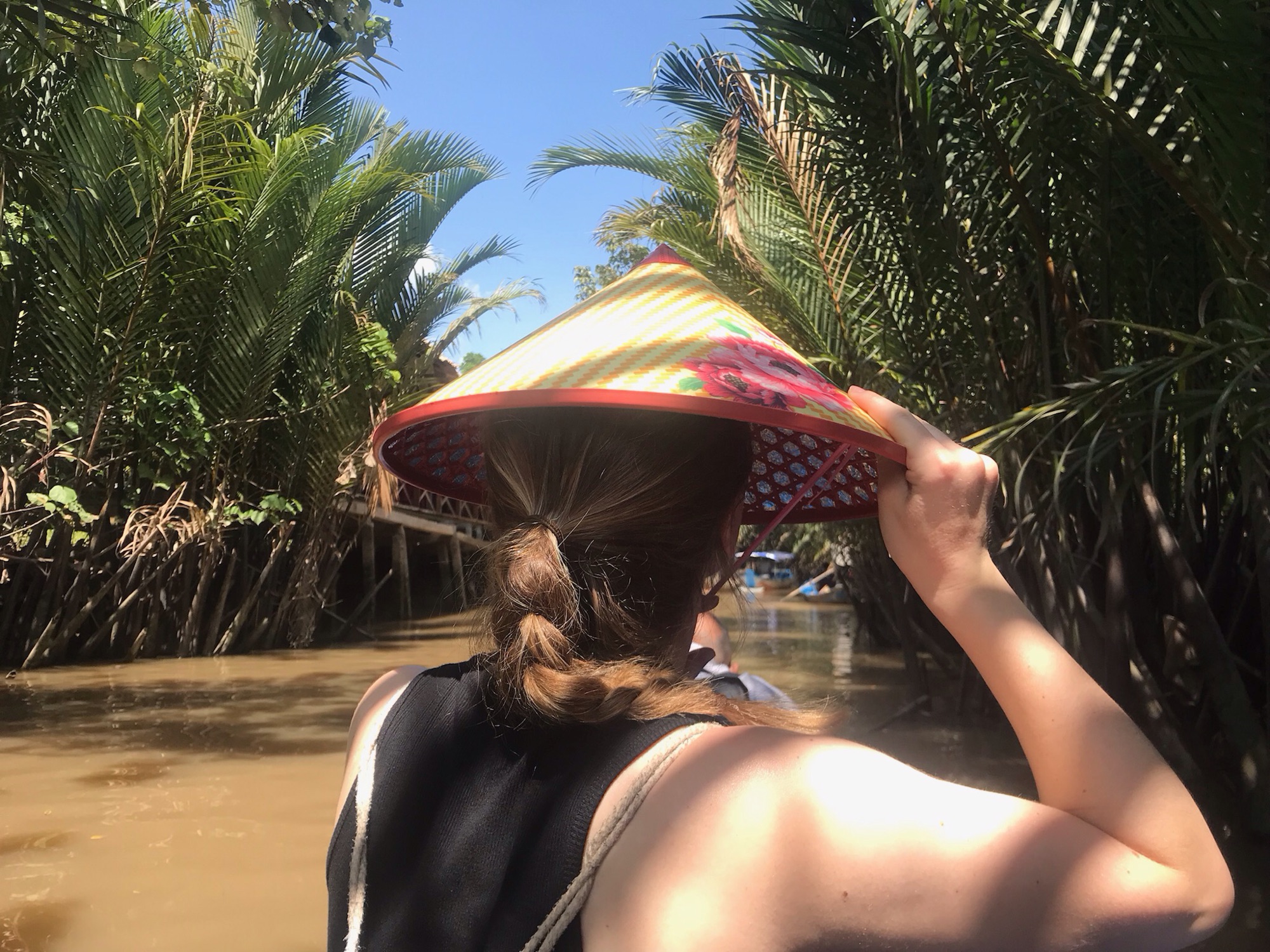
The highlight of the day, though, came after lunch: gliding through the narrow channels of the delta on a small wooden boat, the water shaded by arching walls of bamboo and palm.

It was peaceful, with only the gentle splash of paddles and the rustle of leaves overhead.
After that, we picked up bicycles and pedalled slowly through village paths, past small houses and rice paddies, catching glimpses of daily life on the islands.
Eventually, we boarded the bigger boat again, where fresh coconuts were waiting for us – a welcome treat in the sticky heat – and cruised back across the Mekong.
Then it was back to the dock, onto the bus, and a long ride back through the evening traffic to Ho Chi Minh City. (Tip: bring a good podcast or two for that drive.)
There’s something bittersweet about seeing the Delta: the beauty of the landscape, the resilience of the people who live there, and the knowledge that this way of life is under threat as the river changes.
It’s a long day but if you’re in Ho Chi Minh City and have a day to spare, the Delta absolutely worth the trip.
This isn’t a sponsored post or anything, if you’re interested in the tour we took here’s a link.