
During our trip to Peru, we decided to splash out and take the PeruRail Titicaca train from Puno on Lake Titicaca to the Inca capital of Cusco. It ended up being much more than just a form of transport from A to B but a 10 hour adventure through the remote mountains in old-timey luxury.
Spending money to take a particular train when a much-cheaper bus will do the trick faster often feels like it’s a choice saved for those in retirement with the time and money for the luxury.
That feeling is often cemented for me when I get on said train and am surrounded by pensioners with “Amazing Train Journeys” written on their lanyards or at home, when Sam laughs at me for turning on a very gentle Channel 5 documentary about amazing train journeys after work.

Planning a trip to Peru?
Check out the Peru Travel Guide for everything you need for a trip of a lifetime!
✓ Self-guided car-free adventures
✓ Planning done for you
But the more of these journeys I’ve chosen to take by train, the more I think the pensioner-heavy tour groups are onto something. The chugging train and comfortable chairs may be very gentle, but there is something so adventurous and not intrusive about travelling through remote natural landscapes leaving no roads or other cars behind, but just a single track that’s only used once a day.
That was what I was thinking staring out the back of the open-air observation car watching the track disappear into the difference behind us on the PeruRail Titicaca train from Puno to Cusco in Peru. I was also thinking “This is really flippin cool.”

THE DEETS
Price: $250pp (aka very spenny)
Journey length: 10 hours
Style: old-time luxury, think Orient Express
Views: mountains, alpacas, Andean plains
Link to PeruRail website
A day on the PeruRail Titicaca train
We started our day with an early breakfast at the hotel in Puno, a short walk from the station in Puno. Then, we walked through town to the station for 7am, in good time for its departure at 7.30am.
At the small station, they scanned our tickets, checked in our big bags and then one of the train attendants walked us down the platform into a carriage full of armchair-style seats arranged around dining tables complete with white linens, more like a fancy restaurant than a train car.
The train set off by 7.30am and we went to explore and check out what the train had to offer. There were two passenger/dining cars where our seats were, a bar car and a smaller open-air observation car at the back – without doubt the highlight. (We also checked out the bathroom situation and to our relief they were very nice, not your usual modern train toilets).
By the time we came back, it was 8am and time to order our complimentary welcome drink (ie teas and coffees). They also had an optional breakfast available and because of my inability to turn down brunch, I ordered some well-overpriced $20 scrambled eggs (and thoroughly enjoyed them).
For the first hour, we were enjoying the vibes drinking our coffees and feeling a lot like Hercule Poirot, except rather than solving murders, we were staring out the windows as we went past the banks of the huge Lake Titicaca and people-watching our fellow travellers on the train.
After an hour or so, it started chugging into the city of Juliaca. This created a bit of a buzz and we we knew something was really up as we watched a tour guide leading a group of pensioners wearing “Amazing Railroad journeys” from the other dining car, through our carriage to reach the observation car.
We followed them, and once we got to the observation car with big windows on the front half and an open-air back half, it was clear what all the excitement was about.
The train was slowly picking its way straight through the middle of a bustling market in the centre of the city.
The market vendors were losing no time to get back to business after the train went by.
The second the train had gone past their section, we watched out the back of the car as the awnings were pulled back out, stalls dragged back across the tracks and each section of the bustling market returned before our eyes as if it hadn’t been interrupted by the huge blue locomotive.
The train was moving slowly and the market was long, so for the next 10 minutes we observed the phenomenon. The market vendors were so used to working around the train (which only passes through once per day), that some even had crates of fruits and veg tucked neatly between the tracks, and you could watch it appear below after the train rolled over the top.


After the excitement at Juliaca, the train headed towards much more remote scenery, and the festivities on board really began.
We were invited to the bar car at 9.30 am for a pisco sour and a very loud and vibrant show of Peruvian folk music and dances, with the train’s crew transforming into performers. It was brillliant and a bit bizarre as we sat in the packed bar car with our early morning cocktails (there were non-alcoholic versions available) watching the larger-than-life dances.
Unfortunately for me, they were looking for audience members to participate and Sam decided to volunteer me for the job – lucky me.
The show continued, transforming from a dance show into a fashion show of alpaca and vicuna-hair jumpers, ponchos and scarfs. The models were, of course, the other train attendants.
After the first models ran the make-shift runway and we we were keenly told the clothes were all on offer for passengers to buy (at eye-popping prices), we headed into the observation car to watch the landscapes and alpacas rolling away behind us, with the musicians still providing a great soundtrack.
As lunchtime drew closer and we were further into the journey, the scenery was becoming more rugged, with fewer and fewer buildings. The main signs of life were herds of llamas, alpacas as well as some guanacos and vicuñas (the wild cousins of the domesticated alpacas and llamas).
By 11.40am, it was time to sit down for the three-course lunch.
After lunch, things were beginning to quieten down in the carriage. We and our fellow passengers were fed, watered and realising that a morning of just sitting on a train can be very tiring! (Probably not helped by the 9am pisco sour).
So, we were all happy to get some fresh air when the train’s one stop approached.
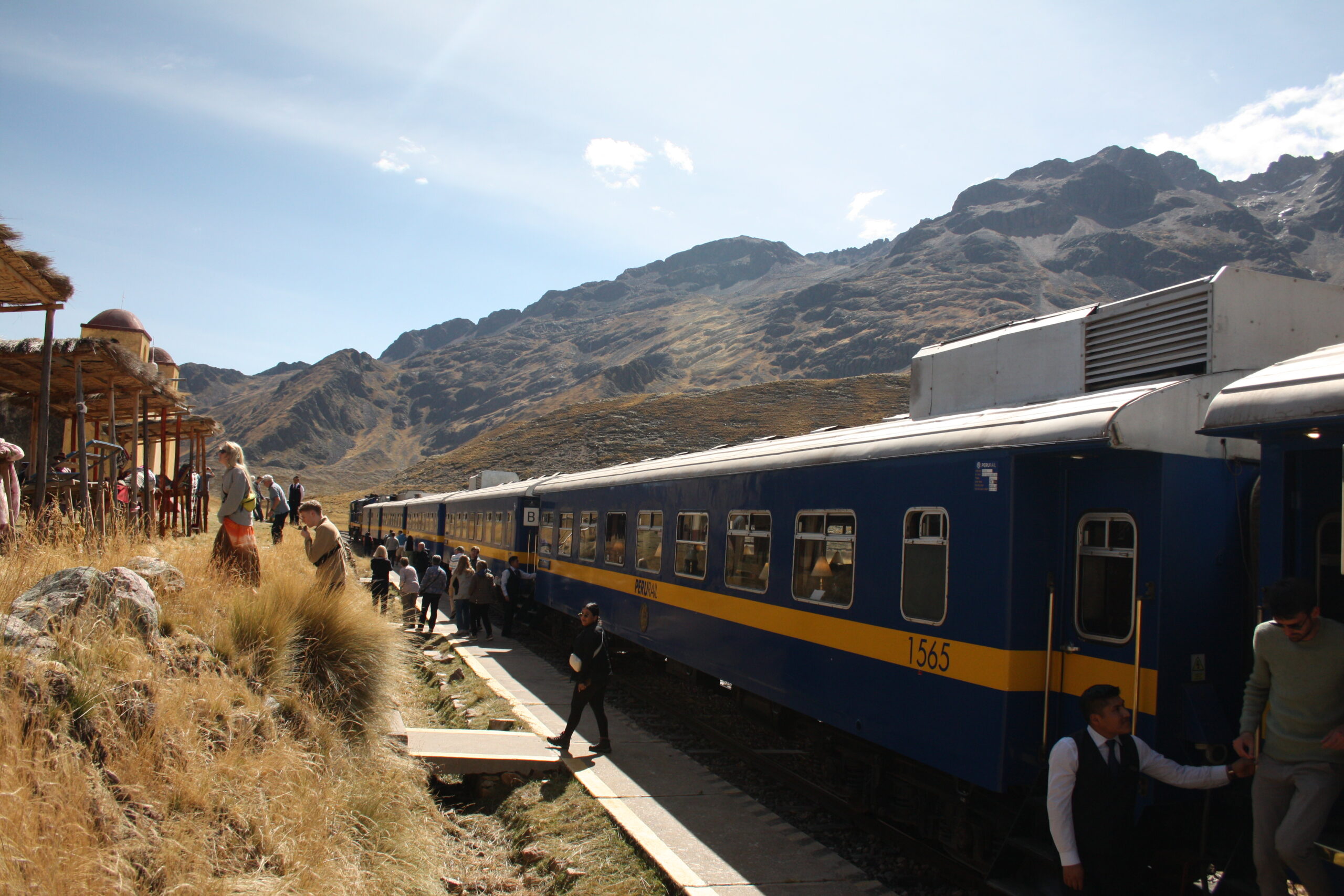
The small platform marked the train’s highest point at 4,800m above sea level. It was in the middle of nowhere with only a church and a few market stands to cater to the train’s tourists, alongside the railway.
The scenery was stunning and we happily joined the throng of passengers gunning for photos of the snow-capped mountains and the blue and yellow train. We looked around the market but didn’t buy anything. Top tip: if you want an alpaca jumper/shawl/poncho/blanket etc, buy it here, it was the cheapest place we saw them.

After stretching our legs, we got back on the train for some much-needed downtime to admire the views from the observation car.
An hour or so later those who still had any energy left joined the crew in the bar car for a demonstration of how to make a pisco sour. We enjoyed this as Sam was called up to be the volunteer to follow the instructions to make it and we ended up with the cocktail for free after.
As the cocktail-making class was ending, the sun was starting to set and the train was heading back into civilisation. That made the observation car a much less enjoyable option as the pollution and dust were hanging heavy over the open-air car.
We returned to our seats where the afternoon tea was waiting for us and by 5.30pm the train had arrived in Cusco. We were exhausted. It turns out staring at incredible views for 10 hours is tiring.
The big question
As you can tell, we thought the day was amazing. But the question is whether the PeruRail Titicaca train was worth the $250pp price tag?
And we would say probably not. $250 each is a lot of money, there are so many other things you could do for that and it is a bit crazy to charge so much for a train ticket, even if it is a tourist attraction.
To put it into perspective, the tourist bus on the same route, which includes lunch and tourism stops, and the overnight bus are a fifth of the price at around $50 per person.
But, the other way to look at it is that the Titicaca train is significantly cheaper than the other luxury trains taking you through the Andes, like the Hiram Bingham.
So, if chugging through remote Andean mountains and pretending you’re in an Agatha Christie novel is something you want to do, this is the cheaper way to do it.
In short, it’s probably not worth $250pp to get from A to B. But it is an extraordinary experience and if you want to do it, that’s how much it’s going to cost you. We loved every minute of it.
Perurail Titicaca Perurail Titicaca PeruRail Titicaca PeruRail Titicaca